This morning I watched a Youtube video of a recent gallery talk , 2026 in Paris I think, by Larry Poons. The big point he made, against a backdrop of large paintings filled with painterly, swirling colour, and very expressive, was that the main tool of the painter was colour. "Colour is the only tool" he said, and rhythm, shape, draughtsmanship, composition all follow from colour. How right he is. Look at Mondrian, Bonnard, Whitney, Klimt, and Joan Mitchell, amongst many; minimal structure and dominant colour.
I first came across the work of Larry Poons in the late 60s while I was at art school in Liverpool, paintings filled with dots and small ovals. Some students were into American painting and working in styles similar to Poons and Frank Stella, and others as well. I didn't really understand it because I was still thinking of the Post-Impressionists, and particularly Cézanne, and then Picasso. Anyway, since resuming my attempts at painting in 2018, and after decades of browsing, studying and teaching Art History, I have instinctively realised that colour is everything. My earlier still-life paintings from 2018 onwards, were as much about colour as anything else, and my recent abstracts are about colour above all. But I have noticed how much art work, on Instagram and elsewhere, is not about colour; the colour is secondary, used to fill in shapes, and is often merely part of a tonal structure.
So where does the colour go on the canvas? It forms shapes - sometimes formed by brushstrokes, sometimes deliberately within contours. But to create sensations of inevitability, like it was meant to be, like it has always been, of being meaningful, is difficult. Avoiding the shallow and the slick is a constant preoccupation. In addition, I'm trying to make the shapes and colours in my paintings and drawings relate to the size and shape of the canvas or paper, and to each other. It could be unconventional, and doesn't need to be a pretty harmony of nice, twee things, but could be a harmony of ugly or discordant things, or contrasting things. And it needs to be real, not flimsy kitsch. It needs to be tough, brutish even. Its beauty can take many forms, should avoid repetition and should surprise as much as possible, because discovering new things in the imagery is a great experience to be encouraged.
I've been reading Art of the Extreme 1905-1914 by Philip Hook. It's a nicely focused book with some new insights about a period saturated with scholarship. On page 268 Hook writes:
Picasso was always wary of artists who talked too much, maintaining that 'in painting an idea will not be pure if it can be expressed in a language other than its own, painting'.
This is very true, to be born in mind at every level. At its purist and most basic level it means no illustration, no depiction, no imitation, no copying of photographs. Mary Gabriel, on page 487 of Ninth Street Women, page, quoted Grace Hartigan:
"One of the most difficult things of all is not to have the painting be a depiction of the event but the event itself," Grace said. "That is the difference between great art and mediocre art. Most art looks like it is talking about something that happened some other place."
I'm just looking at the beautiful tree outside, a lovely Beech in full leaf. If I did a painting of it, it would be perceived as a tree first, not as a painting first. It would be an illustration of the tree, and it would block, or be in the way of, the painting as a thing in itself. This is how I always felt about David Oxtoby's paintings of rock stars, and Warhol's celebrity portraits, based on photographs usually. Do we see through or past the images of Hendrix or Elvis or Marilyn to find the qualities of the paintings? Does the photographic nature of the imagery interfere with our perception of the art? Do the paintings have an existence of their own or are they merely a support for the celebrity illustrations? This is the problem, how to tell, and does it even matter? I am extremely thankful that John Constable had no doubts about what he was doing!
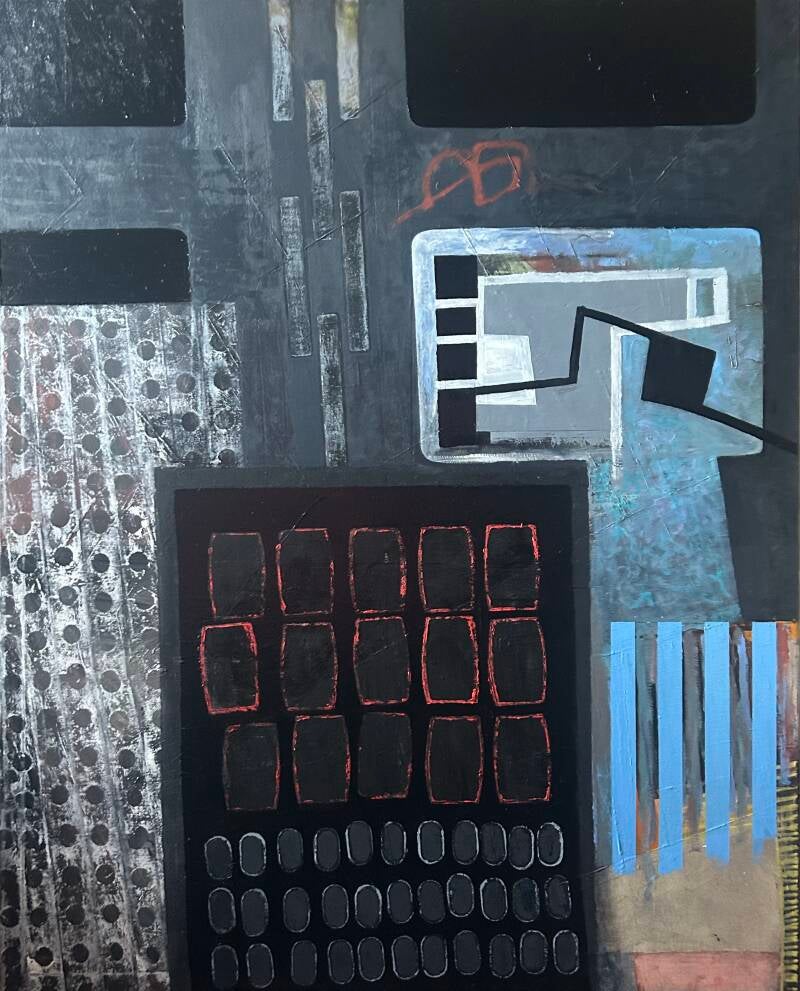
Below are some recent and ongoing paintings which seem to fit this discussion well. Firstly, a big and dark painting, 86x102 cm, made of greys and chromatic blacks, which is still very much unfinished but getting there after several weeks. Nothing pre-planned, and evolving and changing considerably over the weeks.
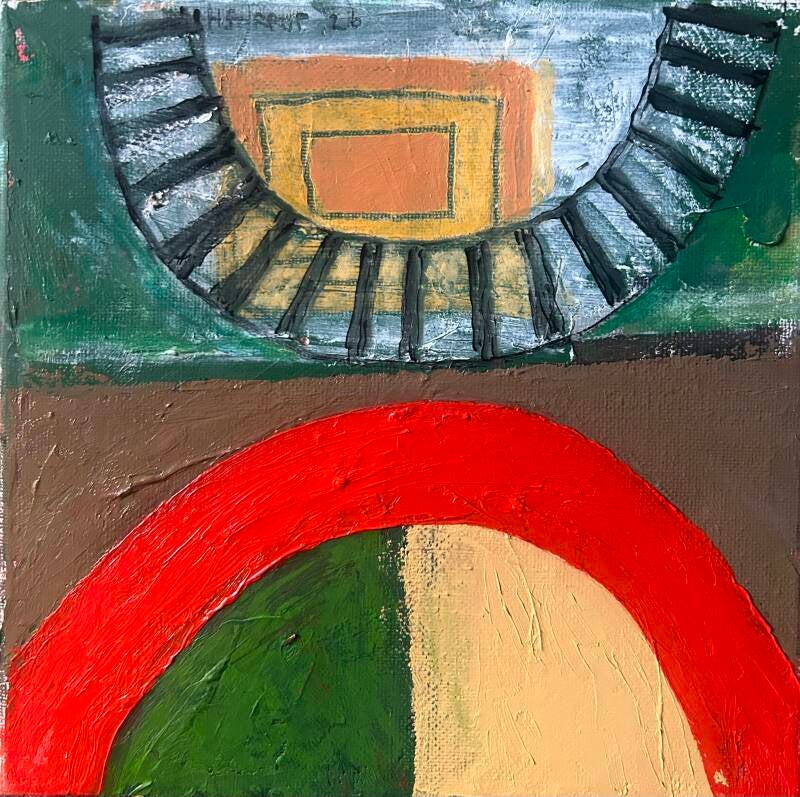
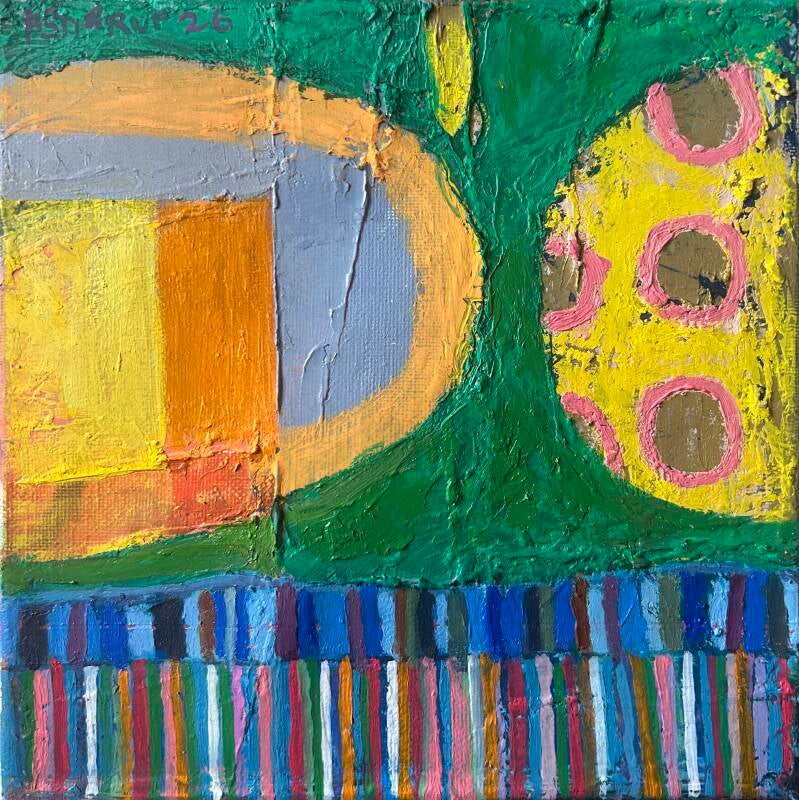
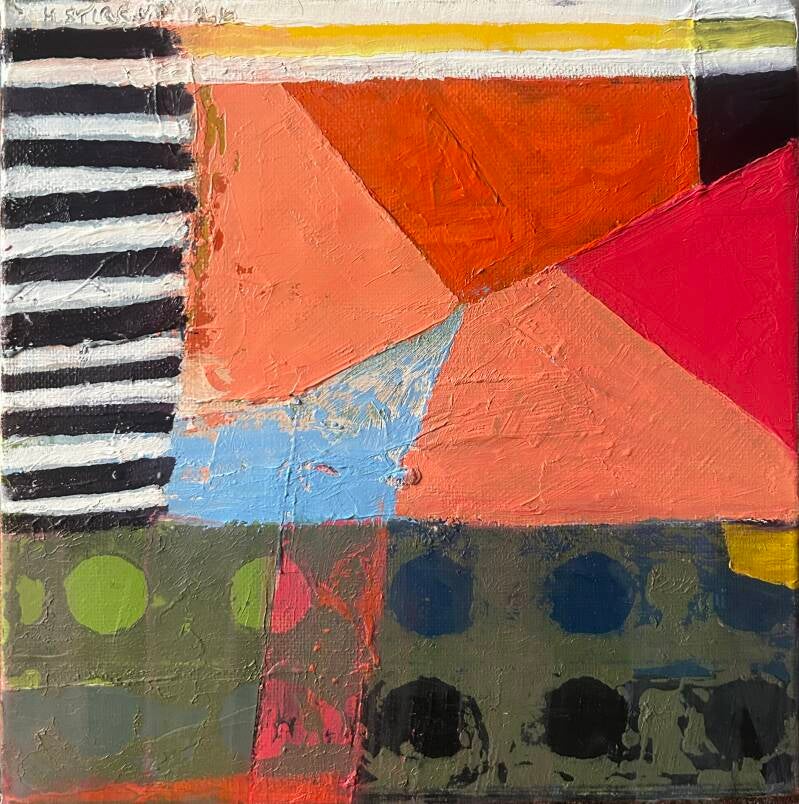
I have also been working on twelve little paintings for a couple of weeks during the drying interludes of bigger paintings. They are each 20x20x4 cm, and worked very directly and boldly in the moment with no pre-planning. Six are in oils and six in acrylics, so a set of twelve or two sets of six or four sets of three! These are the first three to be finished:
Create Your Own Website With Webador